Compare Mortgage Rates: Find the Best Deal

In the previous article, we looked at how to estimate your interest rate and monthly payment based on your personal profile.
Now, the next step is to compare mortgage rates across lenders and understand how rates are structured in the market.
Why Is It Important to Compare Mortgage Rates?
Many first-time homebuyers make the mistake of choosing a loan based on just one lender.
At first, the difference may not seem significant, so it’s easy to assume that comparing multiple lenders isn’t necessary.
However, even under the same conditions, lenders can offer different rates and cost structures.
Even with the same home price, credit score, and down payment, results can vary significantly.
That’s why it’s essential to compare mortgage rates across multiple lenders before making a decision.
How Rate Differences Affect Your Total Cost
A small difference in interest rates may seem minor, but it can have a major impact over time.
For example, even a 0.5% difference in interest rate can result in more than $81,000 in total repayment difference over 30 years.
Your monthly payment can also vary by hundreds of dollars.
This means your lender choice is not just a preference—it directly affects your total cost.
What Should You Look at When You Compare Mortgage Rates?
When you compare mortgage rates, it’s important to look beyond just the interest rate itself.
You should always evaluate these three factors together:
- Rate: The base interest rate applied to your loan → This determines how much interest you pay each month
- APR: The real cost of the loan, including fees and closing costs → Think of this as the “true” cost of borrowing
- Points: Points: Upfront fees paid to lower your interest rate → Paying more upfront can reduce your rate
These three factors work together and determine your overall loan cost.
A loan with a lower rate may come with higher points (higher upfront cost).
A loan with a slightly higher rate may reduce your upfront expenses.
So the goal is not to find the lowest rate, but to find the most balanced structure for your situation.
Compare Mortgage Rates with Real Market Data
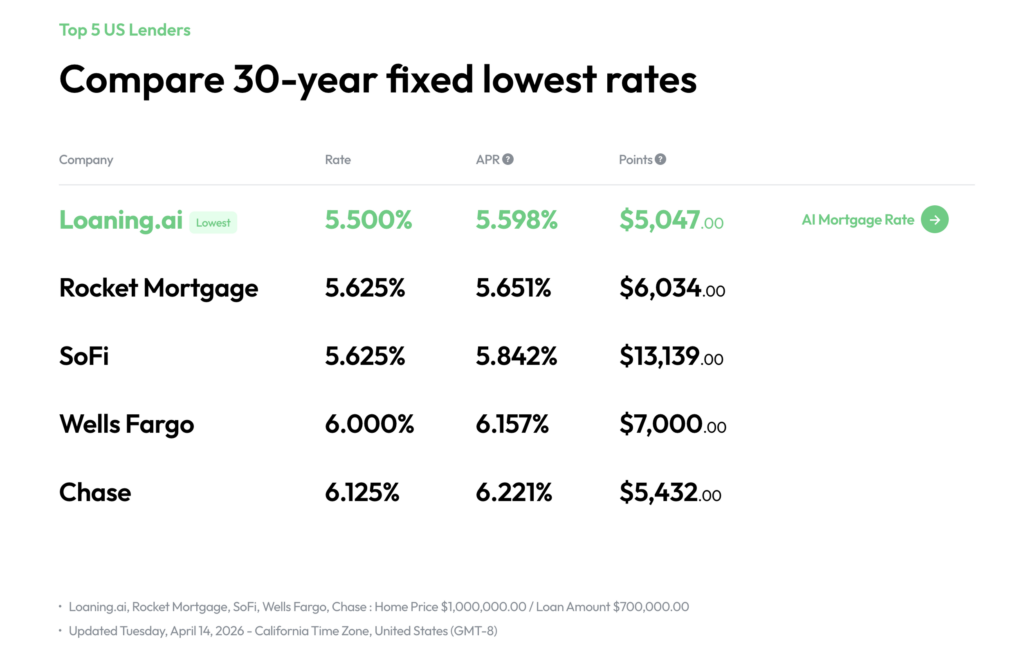
With Loaning.ai’s Compare Rates feature, you can compare mortgage rates across top U.S. lenders under the same conditions.
Example scenario:
- Home Price: $1,000,000
- Loan Amount: $700,000
Based on this, you can compare: Loaning.ai, Rocket Mortgage, SoFi, Wells Fargo, Chase
You’ll see their Rate, APR, and Points side by side.
This allows you to understand how different lenders structure their offers under identical conditions.
What Differences Will You See?
Even with the same inputs, the results can vary significantly.
- Some lenders offer lower rates but higher upfront costs (points)
- Others offer higher rates but lower upfront costs
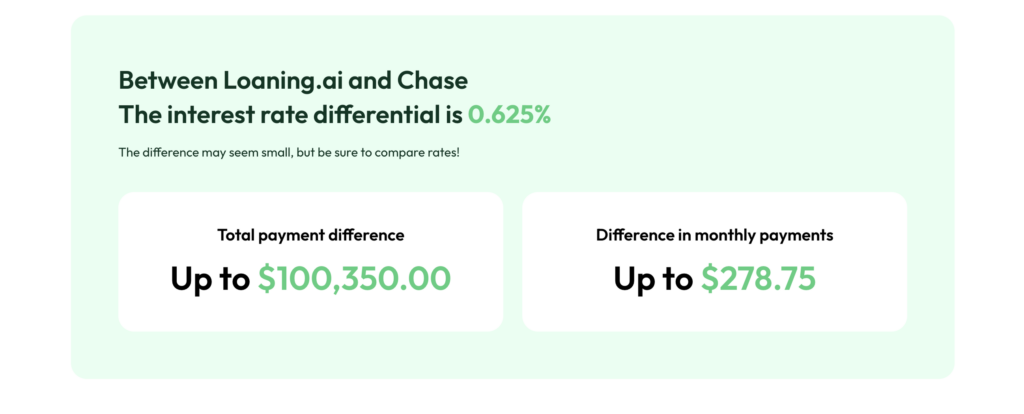
You can also see:
- Total repayment differences
- Monthly payment differences
This helps you clearly understand how rate differences translate into real costs.
Instead of focusing on a single number, you can evaluate the full cost structure of each option.
How to Use Rate Trends to Decide Timing
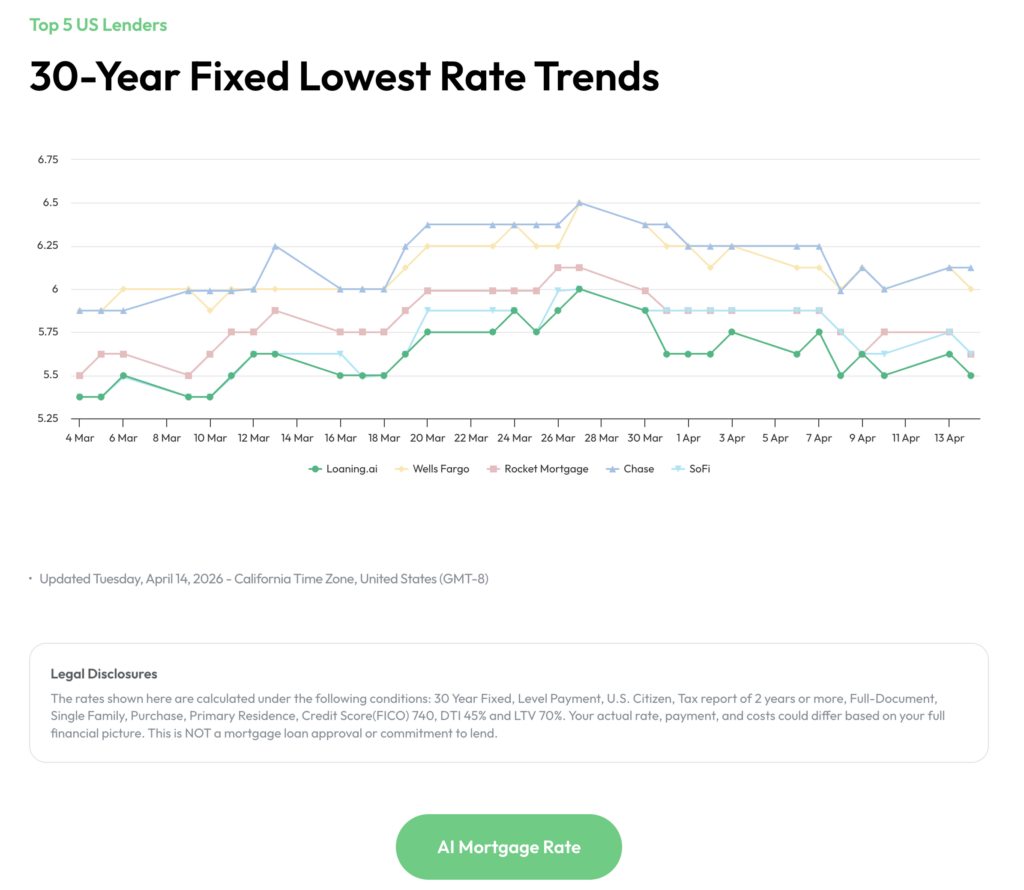
The Compare Rates feature also shows 30-year fixed rate trends over time.
This helps you understand where current rates stand in the market.
For example:
- If rates have been steadily rising → Current rates may be relatively lower before further increases
- If rates are stabilizing or decreasing → It may be worth waiting for better conditions
Another key factor is comparing current rates to recent averages:
- If current rates are higher than average → There may be potential for future decreases
- If current rates are lower than average → Locking in your rate now could be beneficial
However, timing the market perfectly is difficult.
What matters more is understanding where rates stand and choosing a loan that fits your financial situation.
Comparing Multiple Lenders Leads to Better Decisions
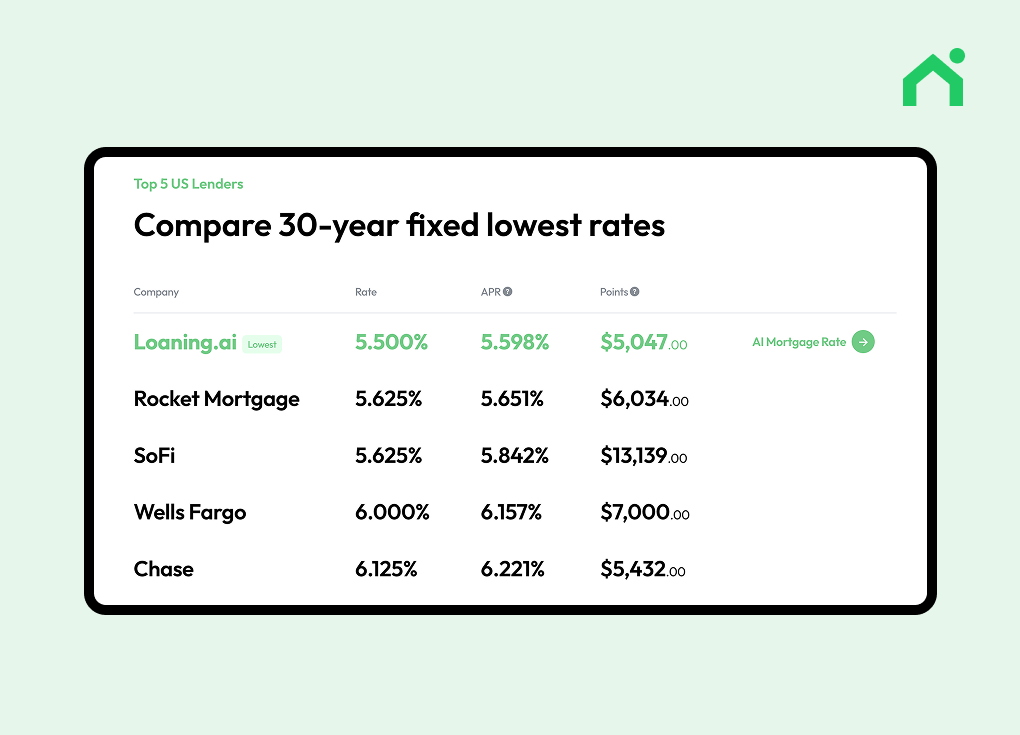
Before making a decision, take the time to compare mortgage rates and understand how different lenders structure their offers.
Even under the same conditions, the differences can be substantial.
By comparing options, you can find the most cost-effective and realistic choice for your situation.