Housing and Childcare Costs Can Consume Nearly All Income in High-Cost Metros
Key Takeaway 🔎
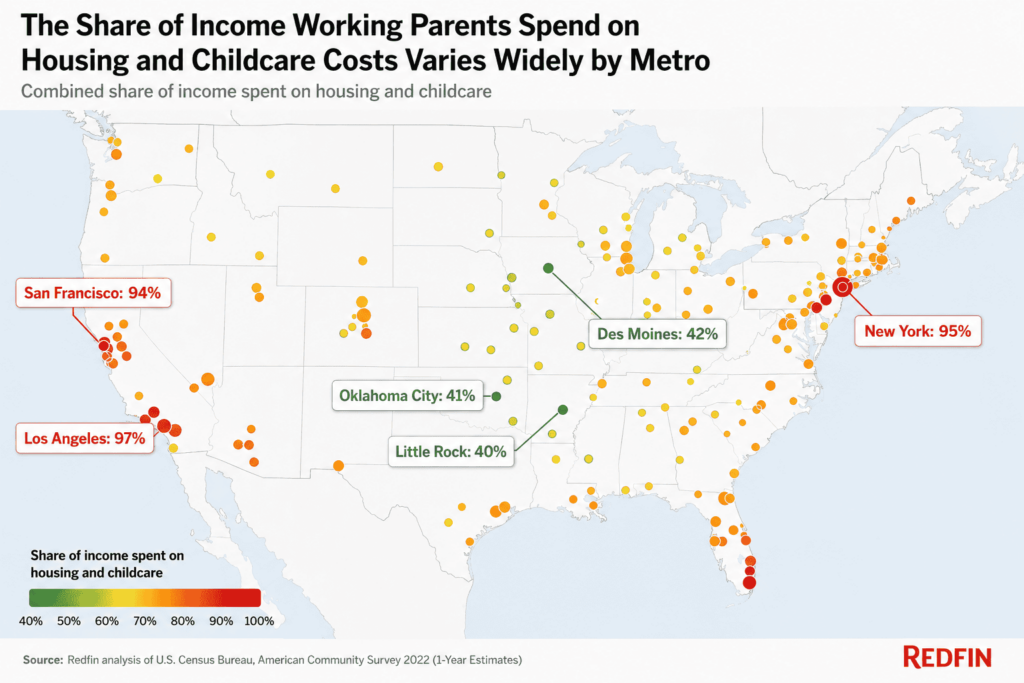
- A home that looks affordable on mortgage payment alone may not fit a family’s full budget. In Redfin’s model, combined housing and childcare costs ranged from 39.8% of income in Little Rock to 96.8% in Los Angeles.
.
Housing and Childcare Costs Can Consume Nearly All Income in High-Cost Metros
For families with young children, the purchase price is only one part of home affordability. A new Redfin and Winnie analysis estimates that a typical working family buying a home today would spend 52% of annual income on housing and full-time childcare for one child. The burden varies dramatically by location.
Among the 100 largest U.S. metro areas, Little Rock had the lowest combined burden at 39.8% of median household income. Los Angeles ranked highest at 96.8%. New York, San Francisco, and Anaheim also exceeded 90%, showing how even relatively high local incomes can be overwhelmed by expensive housing and childcare.
.
Location Changes the Full Affordability Equation
In Little Rock, Redfin estimated annual housing and childcare costs of $29,151 against a median household income of $73,170. In Los Angeles, the combined annual cost reached $94,613, only about $3,000 below the area’s median income of $97,775.
Lower-cost markets in the Midwest and South generally left more room in family budgets. Oklahoma City, Des Moines, Warren, Michigan, and St. Louis joined Little Rock among the most affordable metros by this measure. California and New York dominated the least affordable group, largely because high home prices outweighed the benefit of higher incomes.
Childcare can also change the ranking. In markets with relatively inexpensive housing, daycare may represent a larger share of the combined cost even if the dollar amount is not among the nation’s highest. Buffalo, Rochester, Detroit, Gary, and Springfield, Massachusetts, illustrate this pattern.
.
The Cost Burden Is Highest During a Specific Life Stage
The comparison is most relevant while a family pays for full-time care before elementary school. Costs may decline when a child becomes eligible for public pre-K or kindergarten, but eligibility and remaining expenses vary by place and household. Subsidies, employer support, family care, part-time arrangements, and the number of children can also change the result.
Redfin’s housing estimate uses January through June 2026 market data, a 15% down payment, the prevailing 30-year fixed mortgage rate, property taxes, homeowners insurance, and private mortgage insurance. Childcare uses Winnie’s median monthly cost for full-time daycare for one child. Income comes from the U.S. Census Bureau’s American Community Survey.
.
What This Means for Homebuyers
Before choosing a neighborhood, families should compare the full monthly budget: principal and interest, taxes, insurance, HOA dues, commuting, utilities, and childcare. They should also confirm whether nearby providers have openings, because a listed price does not guarantee availability.
Where local market conditions give buyers room to negotiate, a lower purchase price, seller-paid closing costs, or an eligible rate buydown may preserve cash during high-childcare years. Those concessions are not guaranteed, and their value depends on the loan and seller. Buyers should ask their lender and real estate professional to compare the long-term and upfront effects before writing an offer.
.
Housing and childcare costs should be evaluated together, especially for families planning a move during early childhood. The Redfin-Winnie analysis is a useful metro-level benchmark, but a household’s own budget, childcare eligibility, provider availability, and mortgage terms will determine whether a specific home is sustainable.
.