Korea vs U.S. Real Estate: Key Differences Explained
If you are exploring international housing markets, understanding the differences in Korea vs U.S. Real Estate is an important first step. Many buyers begin by browsing listings on U.S. real estate websites such as Zillow or Redfin, where they can easily access home prices, property details, and school district information.
However, real estate platforms and transaction systems can vary significantly from country to country. What may seem standard in one market can feel unfamiliar in another due to differences in data transparency, agent roles, and transaction processes.
In this guide, we will break down the key differences in Korea vs U.S. Real Estate, focusing on how U.S. real estate platforms work and what to consider when navigating each system.
Data Transparency in U.S. Real Estate: The MLS System
One of the most significant differences in Korea vs U.S. Real Estate is the level of data transparency.
In the United States, most property listings are managed through a centralized system known as the Multiple Listing Service (MLS). Listings entered into the MLS are automatically distributed across multiple platforms, including Zillow, Redfin, and Realtor.com.
This allows users to access consistent and detailed information, such as:
- Historical price data
- Property tax records
- Property features and past renovations
- School district and neighborhood insights
U.S. real estate platforms are designed not only to display listings, but also to provide data that supports decision-making.
In contrast, the Korean real estate market often relies on individual brokerage listings, which may result in fragmented data or duplicated listings.
Agent Roles in Korea vs U.S. Real Estate
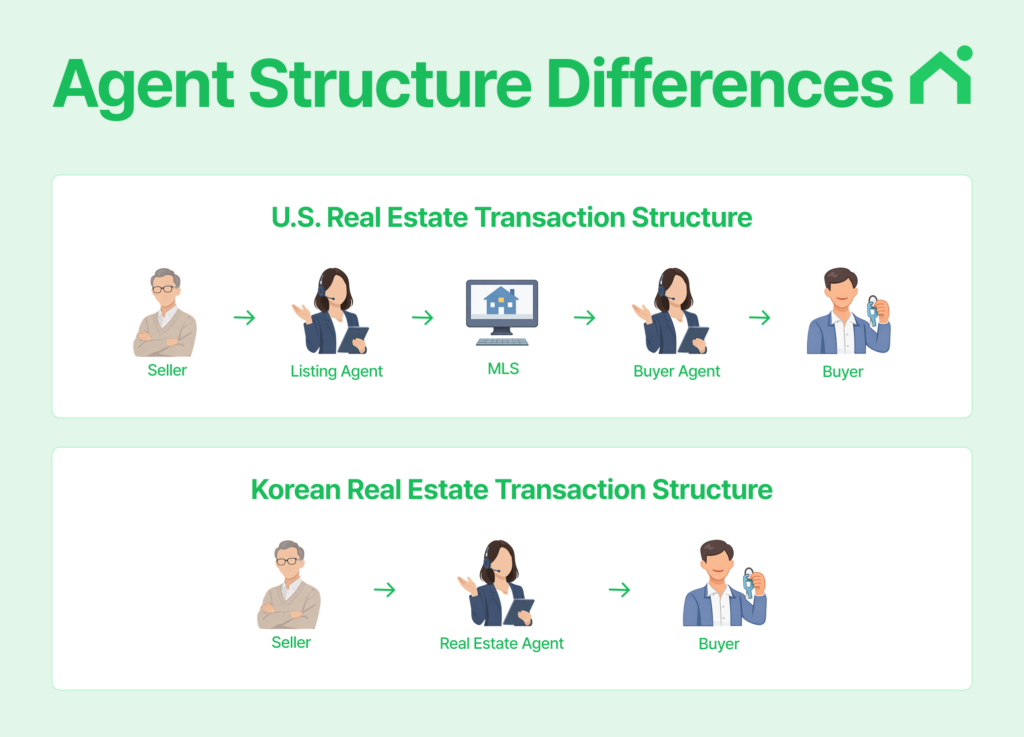
Another key distinction in Korea vs U.S. Real Estate lies in how agents represent clients.
In the United States:
- Sellers are represented by a listing agent
- Buyers are represented by a buyer’s agent
Each party typically has separate representation, and negotiations are conducted between professionals acting in the best interests of their respective clients.
In Korea, it is more common for a single agent to facilitate the transaction between both parties.
This structural difference affects not only negotiation dynamics but also how information is communicated and interpreted during the transaction process.
Inspection and Contract Protection
The transaction process itself also differs significantly in Korea vs U.S. Real Estate.
In the United States, once an offer is accepted, buyers typically conduct a professional home inspection. This process evaluates:
- Structural integrity
- Plumbing and electrical systems
- Roof condition and potential issues
If any problems are identified, buyers may:
- Request repairs
- Renegotiate the purchase price
- Withdraw from the contract
Additionally, U.S. contracts often include contingency clauses, which allow buyers to cancel the transaction under specific conditions within a defined timeframe.
These mechanisms provide an additional layer of protection and contribute to a more structured transaction process.
Major U.S. Real Estate Websites
To better understand Korea vs U.S. Real Estate, it is helpful to explore major U.S. platforms.
Zillow
The most widely used platform, offering a price estimate tool called Zestimate.
Redfin
Operated by a brokerage company, known for fast updates and easy home tour scheduling.
Realtor.com
The official platform of the National Association of Realtors (NAR), known for reliable data.
Cozying.ai
A platform that allows users to explore property listings while receiving both real estate and mortgage guidance from a single advisor.
This approach can be useful for buyers who want a more streamlined experience by connecting property search and financing decisions.
Key Factors to Review on U.S. Real Estate Platforms
When navigating U.S. real estate platforms, it is important to evaluate more than just listing prices. Key data points include:
- Price history
- Property taxes
- HOA fees
- School ratings
- Estimated mortgage payments
These factors directly influence both the total cost of ownership and long-term investment value.
Understanding Korea vs U.S. Real Estate Systems

Korea vs U.S. Real Estate differs not only in how properties are searched, but also in how transactions are structured and executed.
The U.S. system is characterized by:
- Platform-based property search
- MLS-driven data transparency
- Separate agent representation
- Escrow and inspection processes
Understanding these differences is essential for navigating each market effectively, especially for international buyers or investors.
👉 Learn more about U.S. real estate and mortgage insights on Loaning.ai.